How Big is the Universe, Really?
From the first humans gazing at the night sky to today’s astrophysicists armed with advanced telescopes, the scale of the universe has always been one of the most profound mysteries. The universe is vast—so vast that even the word “infinite” seems inadequate to capture its immensity. But just how big is it, really?
To answer this question, we need to combine insights from astronomy, physics, and cosmology. The universe is not just stars and galaxies scattered randomly in space—it’s an expanding, dynamic system whose true size challenges both our instruments and our imagination.
The Observable Universe vs. the Entire Universe
When scientists talk about the “size” of the universe, they usually distinguish between two concepts:
-
The Observable Universe
This is the portion of the universe we can see from Earth. Light has a finite speed—about 300,000 kilometers per second—and the universe has a finite age, about 13.8 billion years. This means there’s a limit to how far we can observe, since light from beyond a certain distance hasn’t had time to reach us yet.Because of cosmic expansion, the observable universe has a radius of about 46.5 billion light-years. This makes the diameter about 93 billion light-years across. In other words, if you could travel at the speed of light, it would take 93 billion years to cross the observable universe.
-
The Entire Universe
Beyond what we can observe lies the unobservable. The actual universe could be vastly larger than the observable portion—possibly even infinite. Current evidence suggests that space is flat on large scales, which implies the universe might stretch out without end.
Why the Observable Universe Is Larger Than 13.8 Billion Light-Years
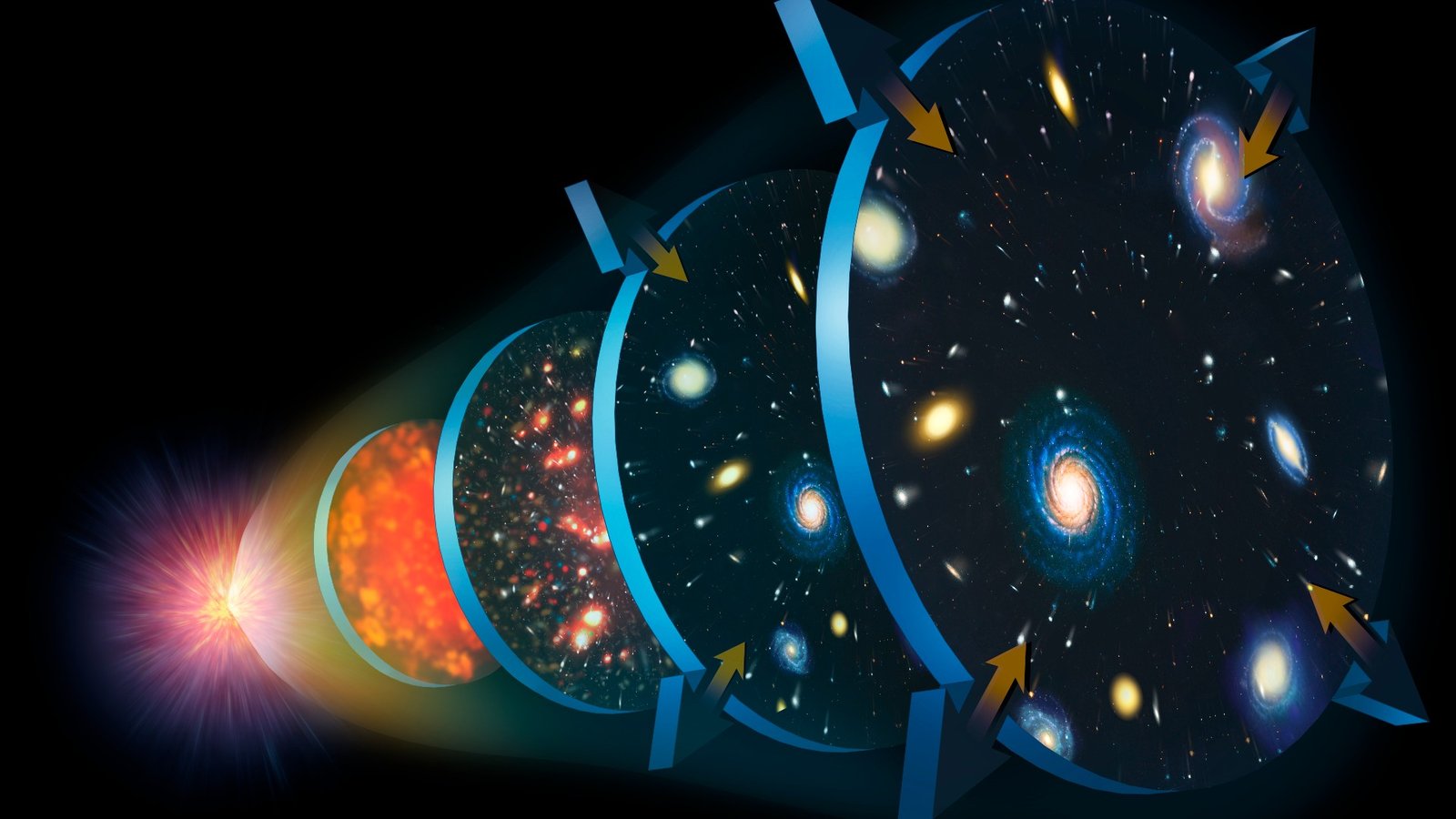
At first, you might think the farthest we can see should be 13.8 billion light-years, since that’s the universe’s age. But due to the expansion of space, distant galaxies have been moving away from us as their light traveled toward Earth.
This expansion stretches the light waves (a phenomenon called redshift) and increases the actual distance to those galaxies. That’s why the observable universe extends 46.5 billion light-years in all directions, far larger than the universe’s age might suggest.
The Universe Is Expanding Faster
Thanks to Edwin Hubble’s work in the 1920s, we know that galaxies are receding from us, and the farther away they are, the faster they’re moving. This discovery led to the idea of the Big Bang, the origin of the universe.
Later, in the 1990s, scientists studying distant supernovae discovered that the expansion of the universe is actually accelerating, driven by a mysterious force known as dark energy. If this acceleration continues indefinitely, the universe’s size will grow without bound.
What’s Beyond the Observable Horizon?
The observable universe is like being in a dark room with a flashlight. You can only see what’s within the beam of light, but the room may extend much farther. Similarly, the universe may continue infinitely in all directions beyond what we can see.
There are three leading possibilities:
-
Finite but Unbounded
The universe could be finite in size but without edges—similar to the surface of a sphere. If you traveled far enough, you might, in theory, loop back to your starting point. -
Infinite
The universe might extend forever. In this case, the observable portion is just a tiny slice of an endless cosmos. -
Multiverse
Some theories, particularly those tied to cosmic inflation, suggest that our universe may be one bubble in a much larger multiverse, with countless other universes existing beyond our reach.
How Many Galaxies and Stars Exist?
The size of the universe can also be measured by counting its contents. Recent estimates suggest:
-
The observable universe contains about 2 trillion galaxies.
-
Each galaxy can have hundreds of billions of stars.
-
This means the observable universe may contain about 200 billion trillion stars (that’s a 2 followed by 23 zeros).
And that’s just the observable part—beyond it could be unimaginably more.
The Smallest and Largest Scales
To truly grasp the size of the universe, it helps to compare extremes:
-
Subatomic Scale: Atoms are about 0.1 nanometers across, and their nuclei are 100,000 times smaller than that.
-
Human Scale: An average human is about 1.7 meters tall.
-
Planetary Scale: Earth has a diameter of about 12,742 kilometers.
-
Cosmic Scale: The Milky Way Galaxy spans about 100,000 light-years.
-
Observable Universe: 93 billion light-years across.
The leap from atoms to galaxies to the cosmos illustrates the staggering range of scales within reality.
How Do Scientists Measure the Universe?
Astronomers use several methods to estimate cosmic distances:
-
Parallax: Measuring the apparent shift of nearby stars against distant backgrounds as Earth orbits the Sun.
-
Standard Candles: Using objects like Cepheid variable stars or Type Ia supernovae, whose brightness is predictable, to calculate distances.
-
Redshift: Observing how much a galaxy’s light is stretched due to expansion, which correlates with its distance.
These tools allow scientists to map the universe with remarkable accuracy.
Could the Universe Be Infinite?
The question of infinity is one of the hardest in cosmology. Observations of the cosmic microwave background—the afterglow of the Big Bang—suggest the universe is flat within a small margin of error. A flat universe is consistent with being infinite, though it could also be finite but extremely large.
If it is infinite, then the implications are staggering: every possible arrangement of matter might exist somewhere, including distant regions with galaxies, planets, or even beings similar to us.
The Fate of the Universe
Knowing the universe’s size also leads us to ask about its future. There are several scenarios:
-
Big Freeze: If expansion continues forever, galaxies will drift apart, stars will burn out, and the universe will become cold and dark.
-
Big Rip: If dark energy grows stronger, it could eventually tear apart galaxies, stars, planets, and even atoms.
-
Big Crunch: If gravity somehow overcomes expansion, the universe might collapse back into a singularity.
Currently, the Big Freeze is considered the most likely fate, given the evidence for accelerating expansion.
Why Does the Universe’s Size Matter?
Understanding the scale of the universe isn’t just a scientific curiosity—it reshapes how we see ourselves. It emphasizes both our smallness and our connection to something unimaginably vast. As Carl Sagan famously put it, “We are a way for the cosmos to know itself.”
Studying the universe’s size also helps scientists:
-
Test theories of physics and cosmology.
-
Understand dark energy and dark matter.
-
Search for exoplanets and the possibility of extraterrestrial life.
The Human Challenge of Comprehension
Even with numbers and models, the human brain struggles to grasp billions of light-years. Our daily experiences operate on meters and kilometers, not cosmic scales. That’s why analogies help:
-
If the universe were the size of Earth, the observable part would be a tiny grain of sand.
-
Or imagine shrinking the solar system to the size of a coin—then the observable universe would still be larger than the Earth itself.
Such comparisons hint at the overwhelming magnitude of what lies beyond our immediate perception.
Final Thoughts
So, how big is the universe, really? The truth is both astonishing and humbling. The observable universe stretches 93 billion light-years across, containing trillions of galaxies and unfathomable numbers of stars. Yet this may be only a fraction of the entire cosmos, which could be infinite.
The size of the universe is not a fixed measurement but a dynamic, ever-expanding reality. With each new telescope, probe, and discovery, our understanding deepens—but the full scale may forever remain beyond our reach.
What matters most is not that we can measure every corner of existence, but that we continue to explore, wonder, and seek meaning in the immensity around us. The vastness of the universe is a reminder of both our fragility and our extraordinary ability to comprehend.